Prāna:
Story of a Painting
Jan 6, 2022
I was on the acupuncturist’s table, filaments in and eyes closed, wondering why the Sanskrit word prāna is written the way it is in the Devanagari script. As my mind wandered, I breathed. In and out, in and out, but the mind kept wandering and wondering. I decided to do the deep belly breaths to focus on the breathing again. I am terrible at this meditation thing. My mind is joyous in its wanderings.
Script:
As I exhaled, I focused on my stomach moving towards my back, belly button to spine. And then I love how the inhale just follows, air rushes in and the stomach balloons up. I remembered how low pressure and high pressure worked. I remembered how it shows up in yoga when as you exhale you squeeze everything out and as you let go, air rushes in and fills you up again.
That’s when I saw the form of the letters, the Pa and the Na—I don’t even know how to write the last letter in English, the nasal Na.
I look it up:
The most common English spelling of the Sanskrit word प्राण (prāṇa) is Prana. It is often used in the context of yoga, Ayurveda, and other Indian spiritual and wellness practices.
The pronunciation in English is typically /ˈprɑːnə/ (PRAH-nuh).
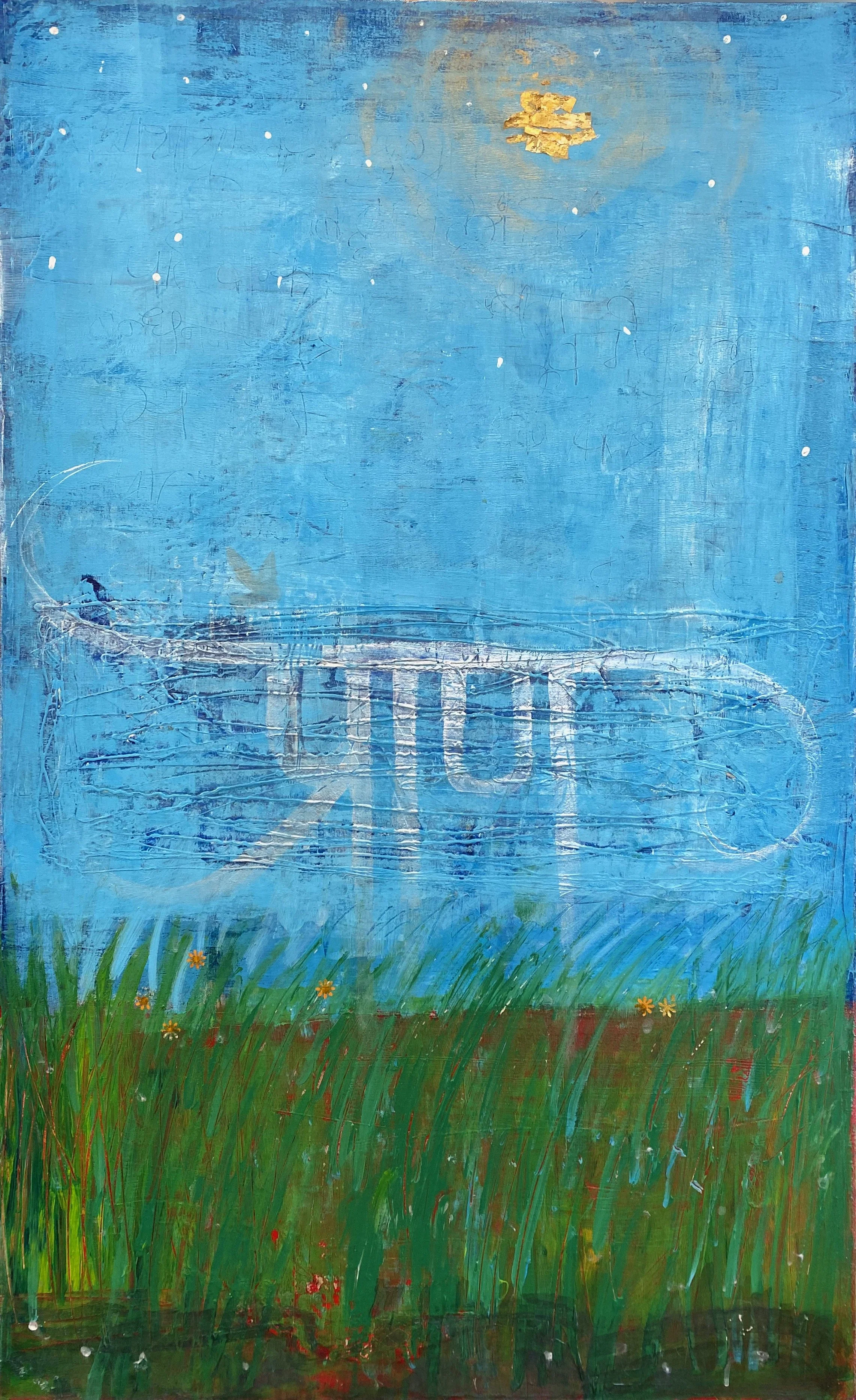
It’s like the letters are the same exact shapes just the Pa is the balloon of the stomach stuck to the vertical spine and the Na is the balloon of the stomach away from the vertical spine! The stroke coming out from where the Pa balloon meets the vertical line is the Ra and it brings our attention to how it is all pinched! As I breathed on the acupuncture table and tested out my theory, I saw it clearly. In and out, no out and in, out and in. One intentional—the exhale—and the other automatic. Yes, the exhale is first then the inhale because that’s how the letters are arranged. Not NaPra, but PraNa. So it is like the word itself tells us how to do it! So beautiful!
Later, I told the doctor and he told me how he has wondered about Chinese script too. There is definitely meaning behind the design of old scripts and characters. I knew from my work on a book, the original pictographs came from drawings.
Upanishads:
Dena had commissioned me to create a painting for her of the word Prana. She was opening a new meditation space on her organic farm and wanted it to hang there. She sent me 5 images from various Upanishads where she found verses about breath. “I am more interested in your calligraphy than the colors of what I’m sending,” she wrote. “I’m interested to see which Upanishad strikes you.”
As I read them all, I knew exactly which one. It was the last one from the Chandogya Upanishad (Again? The song Dena had created for the Diwali program inspired by my book Little Lantern and the Dark & Moonless Night was also from this Upanishad). Here, the bird is the wandering mind, tethered to breath. It can only go so far and eventually comes to rest where it is bound, at breath. And so it was that the description in the Chandogya Upanishad spoke to me, to my bird mind, always wandering. Maybe now, this understanding, would help me learn how to meditate…
Anyway, it spoke to me so clearly because The Bird has been an image that has been with me for a few years now. I remember vividly when I entered the first of the old royal tombs at Shah-i-Zinda, in Samarkand, Uzbekistan when we visited in 2018. The guide, Dilnoza, translated for me the poem written in the gorgeous tilework above the entrance:
Poor Bird. He doesn’t know that his final resting place is on the ground.
With the beauty of that in mind I entered the dark space. As my eyes adjusted, I heard the unmistakable sound of a pigeon. A pigeon? I looked up and there was a small arched window up high. It was glassed in, and there was a pigeon pacing back and forth, mumbling to itself, as pigeons often seem to do. I stopped and took a video. It felt familiar somehow.
Later in my Jungian courses one of the instructors suggested I was Bird Girl as many things came to me in bird stories or references. Sometimes it was a balloon, held by a stern hand, allowed to wave this way and that but unable to fly away on its merry way. Or a rowboat tethered tightly, always bumping around on wild waves wanting to be free.
Breath?
I was excited to show this idea of the script to my father-in-law, Tapas Mazumdar. A retired professor of calculus, he is happy to see my mad ideas and theories. We sit and discuss them, learning, imagining, theorizing. When I told him I had been commissioned to make an artwork about the Sanskrit word for breath, prāna, and showed him my drawing he shook his head.
“But prāna is not translated as breath,” he complained, eyes closed, fingertips of his two hands touching each other at his mouth. “Prāna is life force energy. Breath, our inhale and exhale, is just one of the few things that make up the life force energy,” he explained.
Breath is Nishaas in Bengali, he pointed out. श्वसनक्रिया or Shwasankriya in Sanskrit. Then he told me about how yogis hope to reach the point in their practice where they don’t inhale/exhale yet they live on. What are they living on? He told me about the idea Breathless is Deathless. How do they do that?
I remembered of course about chi. And also that there are other forces of energy in our bodies, the chakras. Then there is the air and sunlight around us. The earth and the elements seem to want us to be alive too, somehow.
Colors:
As I had read to my Color Stories Journal class from the book Colors: What They Mean and How to Make Them by Anne Varichon, the plants have been making oxygen for us for millions of years even before we were ever imagined. The atmosphere has been keeping it close to the surface and the rains have been purifying the air. The earth energy is always holding us, each one of us.
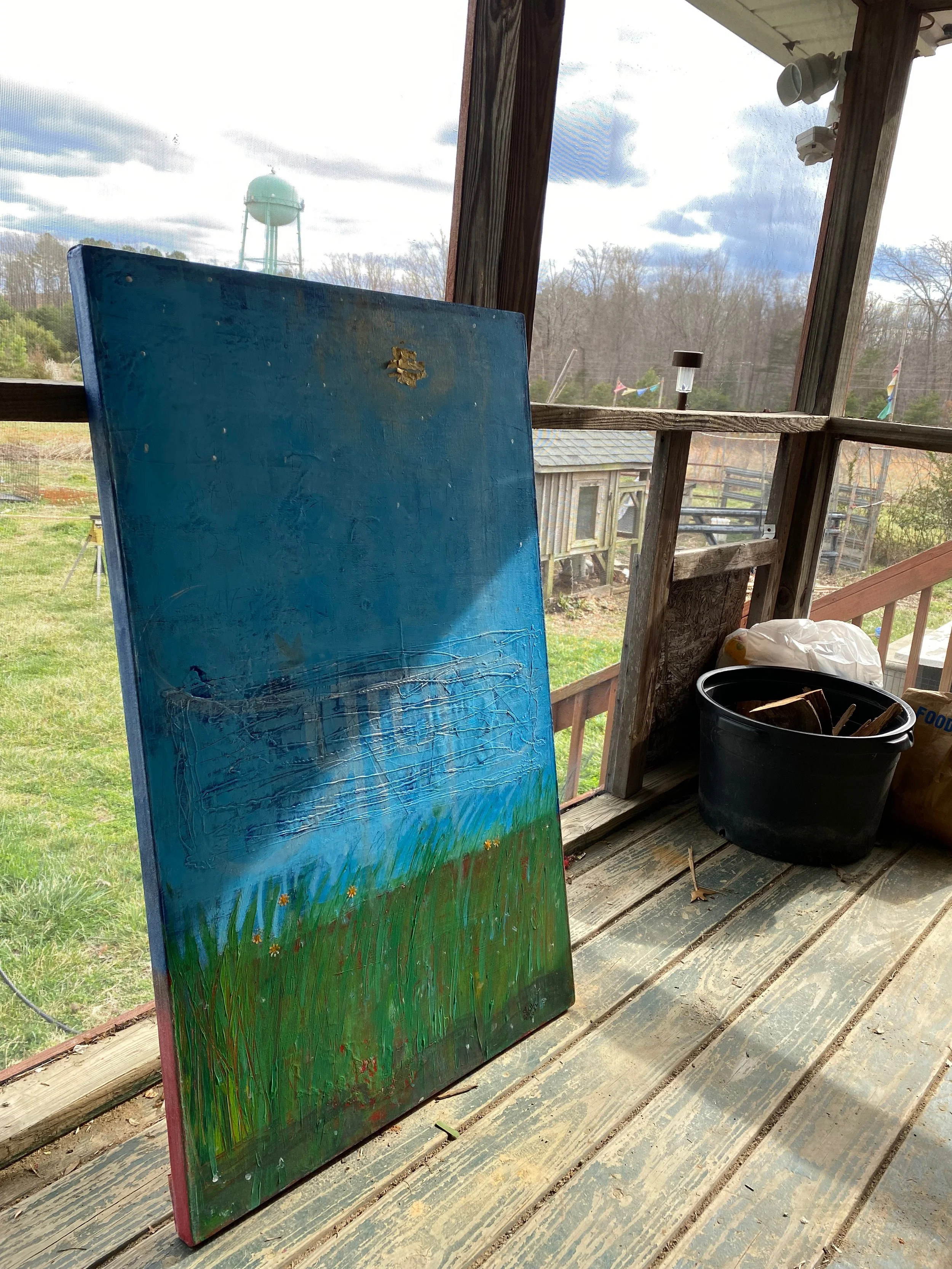
I also found my colors in the Chandogya Upanishad artwork, blue and green, and so I painted them and then added some more. The blue of the night sky painted over with the blue of the daytime sky, as air is eternal, unseasonal, omnipresent. Then, I added the red of the root chakra, the earth energy, the red of the earth. And the green in thanks to the plants and how they make the oxygen we breathe. In Braiding Sweetgrass by Robin Wall Kimmerer, which I just finished reading, she talks about reciprocity and how even as we destroy nature she keeps making us the oxygen we breathe. And how when we breathe we in turn give plants the carbon dioxide they need. We are intertwined like that, needing each other to survive even though it might not look like it, even though one of us takes more and more, greedily, destructively.
Calligraphy:
Dena wanted me to make her some calligraphy but it turns out I wanted the letters to be very clearly and simply seen, unlike a lot of my expressive mark-making work where I instead try to capture the spontaneity of writing lyrics as my favorite Hindi songs play. This time I wrote over and over, wiping, re-painting. It had to be stable, clear, ephemeral. I wanted Dena to see the stomach and spine in the letters, even as she had just retired from 30 years working as a physician.
A visitor to the Studio, PAUSEr Kathy said she saw the verticals of the letters going into the ground, so it can pull up energy from there.
Canvas:
I wanted the canvas to be big, to hold all that space that air and earth would take up, surround us with. I looked at my various blank canvasses. Too small or too big or just… not right somehow. Then, as I slept I saw a painting which hung on a wall in my studio, a canvas taller than the rest. Given to me many years ago by LouLou, an old painting she didn’t want anymore. After that it was all done in a day. My bad drawing of the tree that stands outside my studio window is finally erased, or perhaps freed into the big sky. The poems are still underneath. My poem, handwritten in water-soluble graphite about how spring will come again lies buried in the red earth of Prana, knowing it will indeed come, as we learn to care for our dear planet like Dena teaches us in the way she works her organic farm. And we will continue to enjoy the life force we are so generously gifted.