Our Histories Are Connected!
Cornwallis: Virginia and Bengal
As I thought about making art for our Virginia 250: A Community Art Exhibit, I immediately thought of the “Cornwallis Story,” from when my son was in fourth grade studying Virginia history. Thinking of how it connected the history of Virginia to my ancestral home of Bengal, India, I decided to use the red alta, a liquid used by women to decorate their feet during celebrations in Bengal, to write “Cornwallis” using the gorgeous Bangla script.
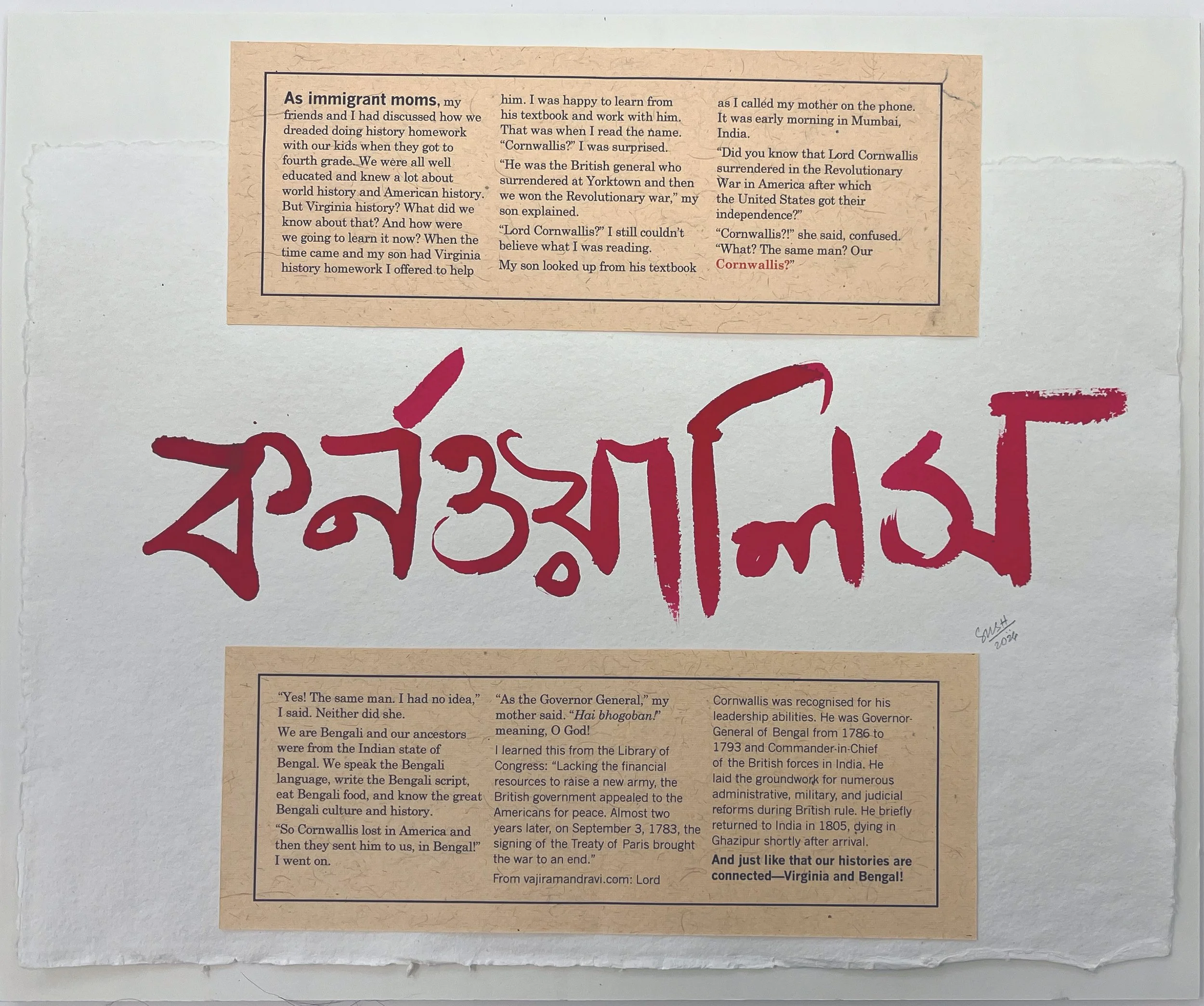
Photo, below: “Cornwallis” - Our Histories Are Connected (2026) Mixed media on Indian handmade khadi paper
But, do I know how to write Cornwallis in Bangla? It is not a word your mother teaches you to write when she insists you learn to write your mother tongue when you are young. I could Google it but that would show up in a “font”. However, what I love is the cursive handwritten form of the script! It rolls and curves and is just gorgeous! So I asked my mother-in-law to write it in her beautiful cursive, take a photo on her phone, and text it to me. I looked at her writing and tried to write it in my own way with a Chinese brush dipped in red alta.
I had found the khadi paper I had saved and was excited to use it for this project. Khadi paper is Indian, handmade, cotton rag paper. The khadi movement was started when India was a British colony and Mahatma Gandhi wanted people to be self reliant and make cotton themselves, at home, rather than have to buy expensive British made fabric made from Indian cotton. It seemed perfect for this project. But as I looked to order more, the only khadi paper I could buy was from the UK! I only had five sheets left from a previous purchase. I had to make at least three artworks.
As I researched the actual story I found some interesting information from the Library of Congress. I also found an Indian website used to train students for the Indian Administrative Service exams where they told of Cornwallis’s reforms in Bengal. So the celebratory alta made sense! I also learned that he returned to India a second time and died there! Wow, what a story that turned out to be!
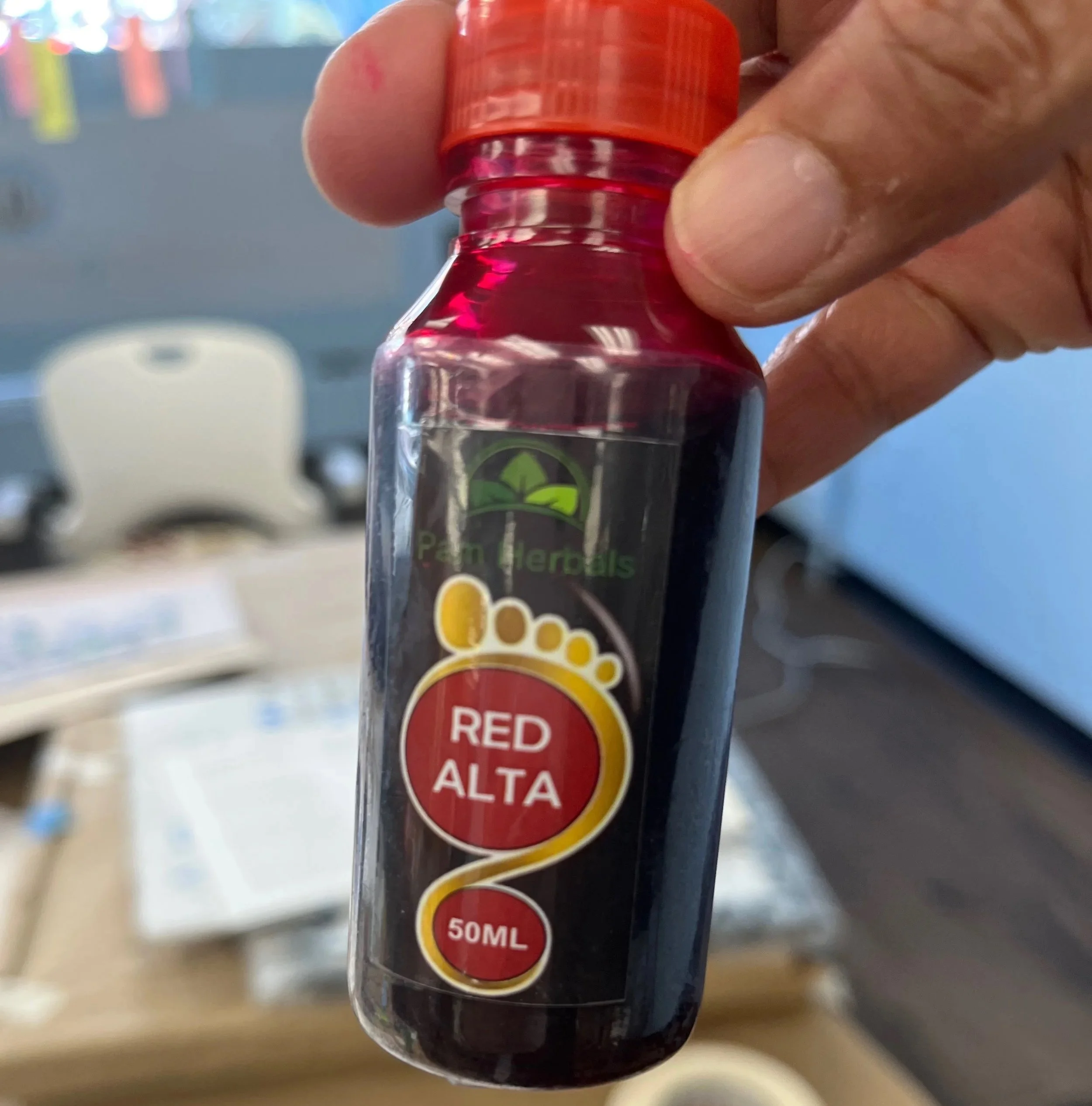
Photo, above: The small bottle of alta was inexpensive and was shipped from New Jersey.
Pav Bhaji: Virginia and Mumbai
When I wondered if there were other stories like this I could make into art, my husband shared the story of the origins of my favorite street food, Pav Bhaji, which he had heard on a podcast (also British!). “It’s thanks to President Lincoln that you have Pav bhaji,” he smirked. I did my research and found it connected U.S. Civil War history to my hometown of Mumbai! I wrote the words Pav Bhaji in the familiar Devanagari script used to write the Marathi language. It was also used to write Sanskrit and Hindi, both languages I learned in school. I wrote it using turmeric I brought from my kitchen.
But as I researched how to work with turmeric on paper I found that it needs a binder. Gum arabic was reccomended. I ordered some. One day, Sharmila Karamchandani, a friend and PAUSEr came by and I told her about wanting to write with turmeric. As a fellow Mumbaikar and lover of pav bhaji, she found instructions on how to mix it and went ahead fearlessly. Once the “paint” was ready I got a brush and wrote it on the second sheet of khadi paper.
Looking up the story of President Lincoln banning the U.S. South from exporting cotton I found a first-hand diary entry of a man who visited the cotton “manufactories” in Virginia. It was cool to read the story and see the photos. Growing up in Bombay, as Mumbai was know in my childhood, I knew the stories of the cotton mills and the 1982-83 strike, and the 250,000 workers who could not go to work because the 80 mill owners and union could not come to an agreement. “After a prolonged and destabilizing confrontation, the strike collapsed with no concessions having been obtained for the workers.” Later in the 90s I would see those mills sold off in huge real estate deals and luxury apartment complexes and malls built on those lands.
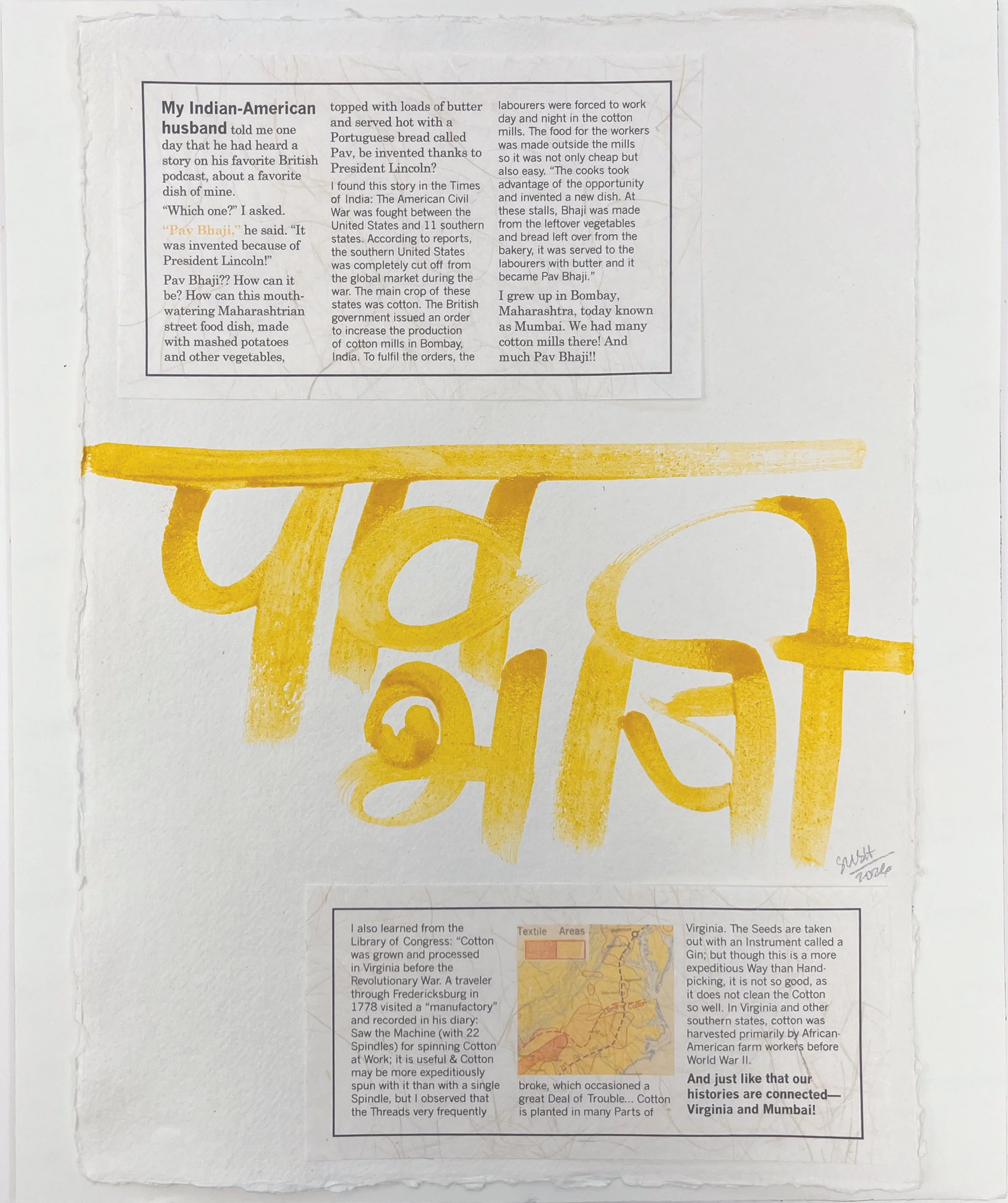
Photo, above: “Pav Bhaji” - Our Histories are Connected, 2026
What story would be next?
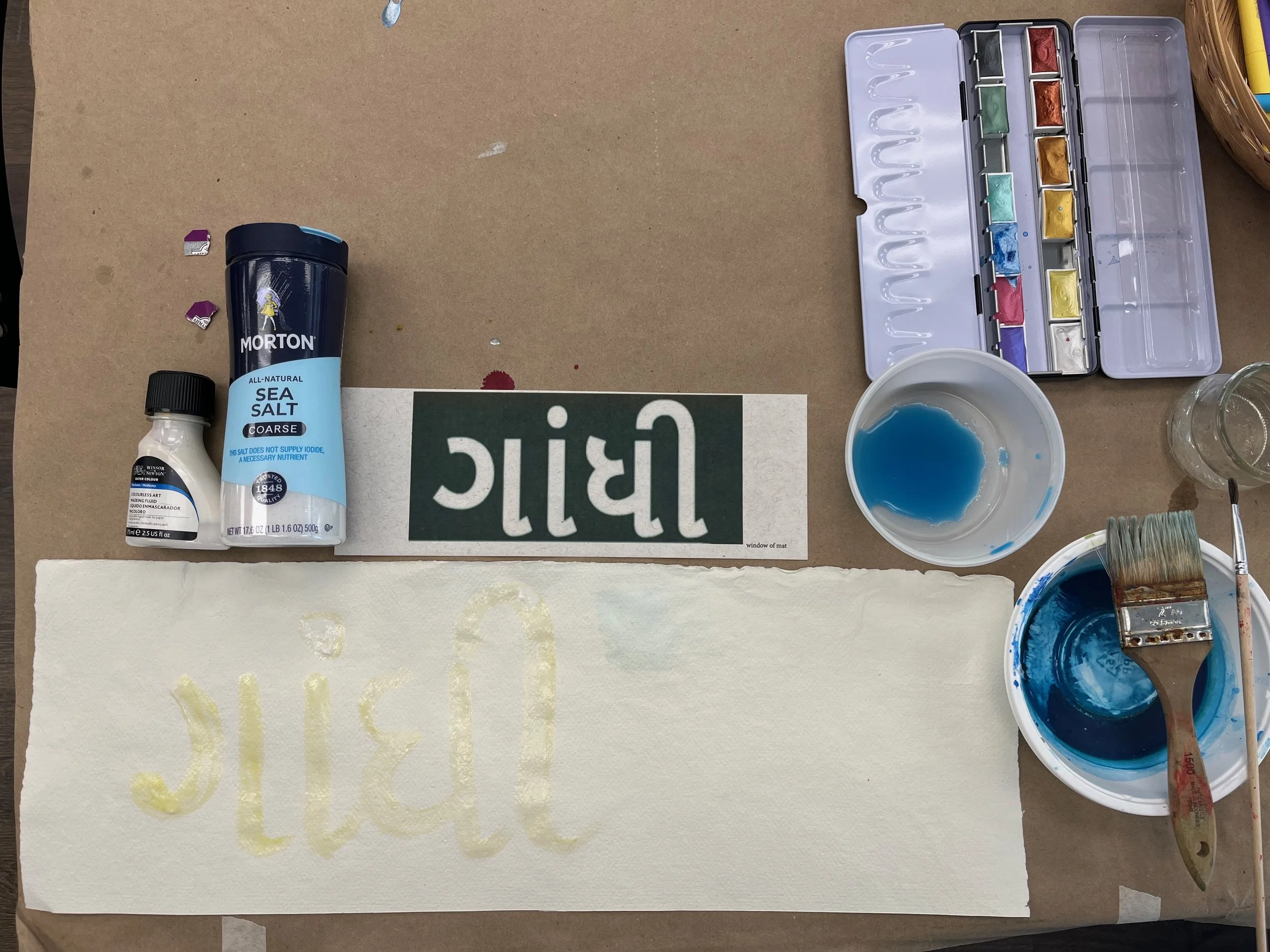
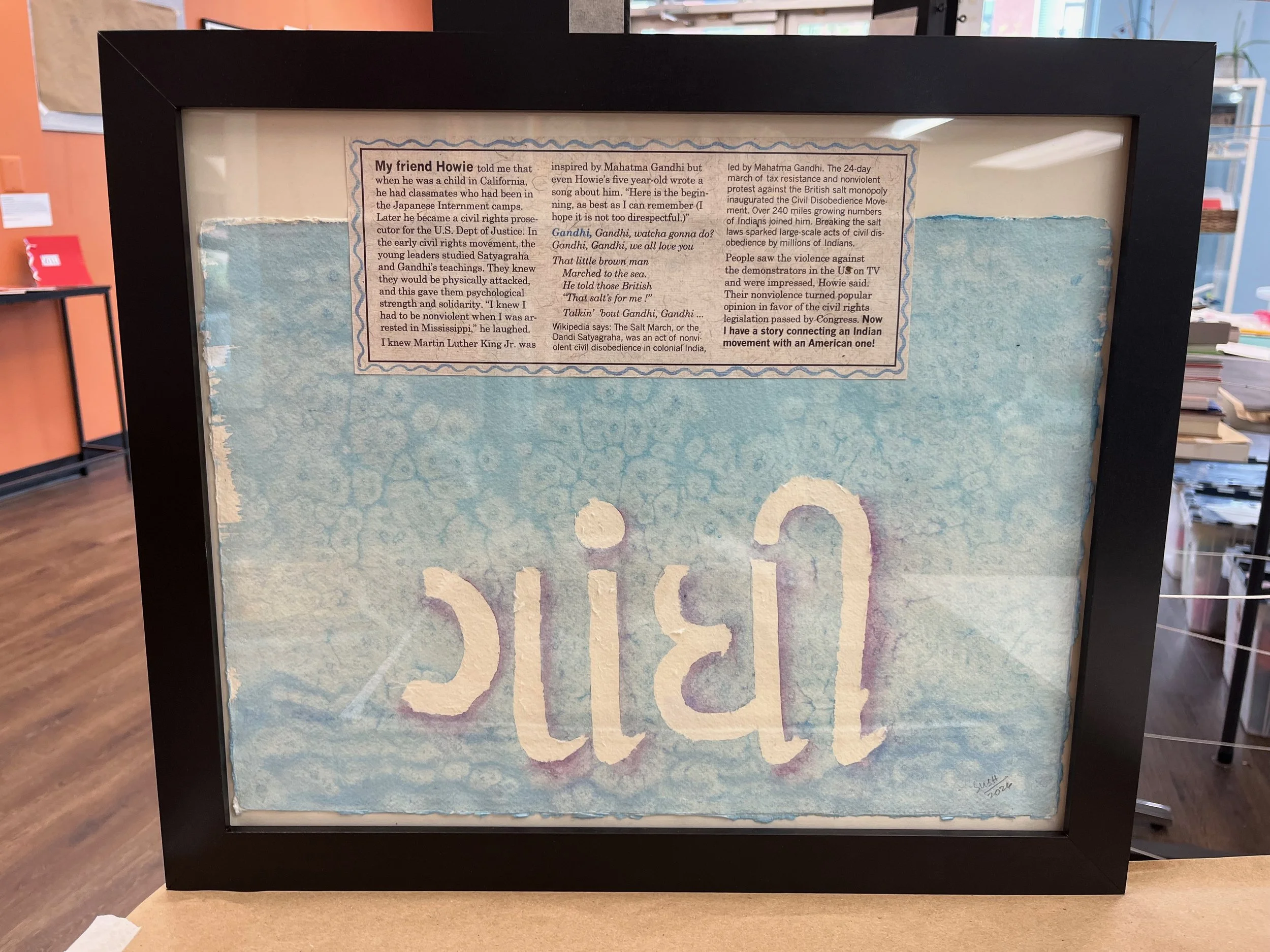
When I told my friend Howie about this series, he gave me a story which connected the U.S. Civil Rights Movement to the Indian independance movement. And the first few lines of a song his five year-old daughter had written! It was about Gandhi’s Salt March to Dandi, a place on the coast of Gujarat, India, from where he took salt and refused to pay the British tax on it.
I remembered learning how to work with watercolors in a book arts masterclass I had taken in Berlin in 2025. My usual work is in book arts, acrylics, and mixed media so when she taught us how salt crystals resisted watercolors, I had been so excited I had gone to a famous art supply store that evening to buy myself watercolors. I found a gorgeously designed watercolor box with stunning mettalic watercolor paints. But I had never used it as it felt too precious. Now was definitely the time. As salt was part of the story I brought a bottle of salt from home.
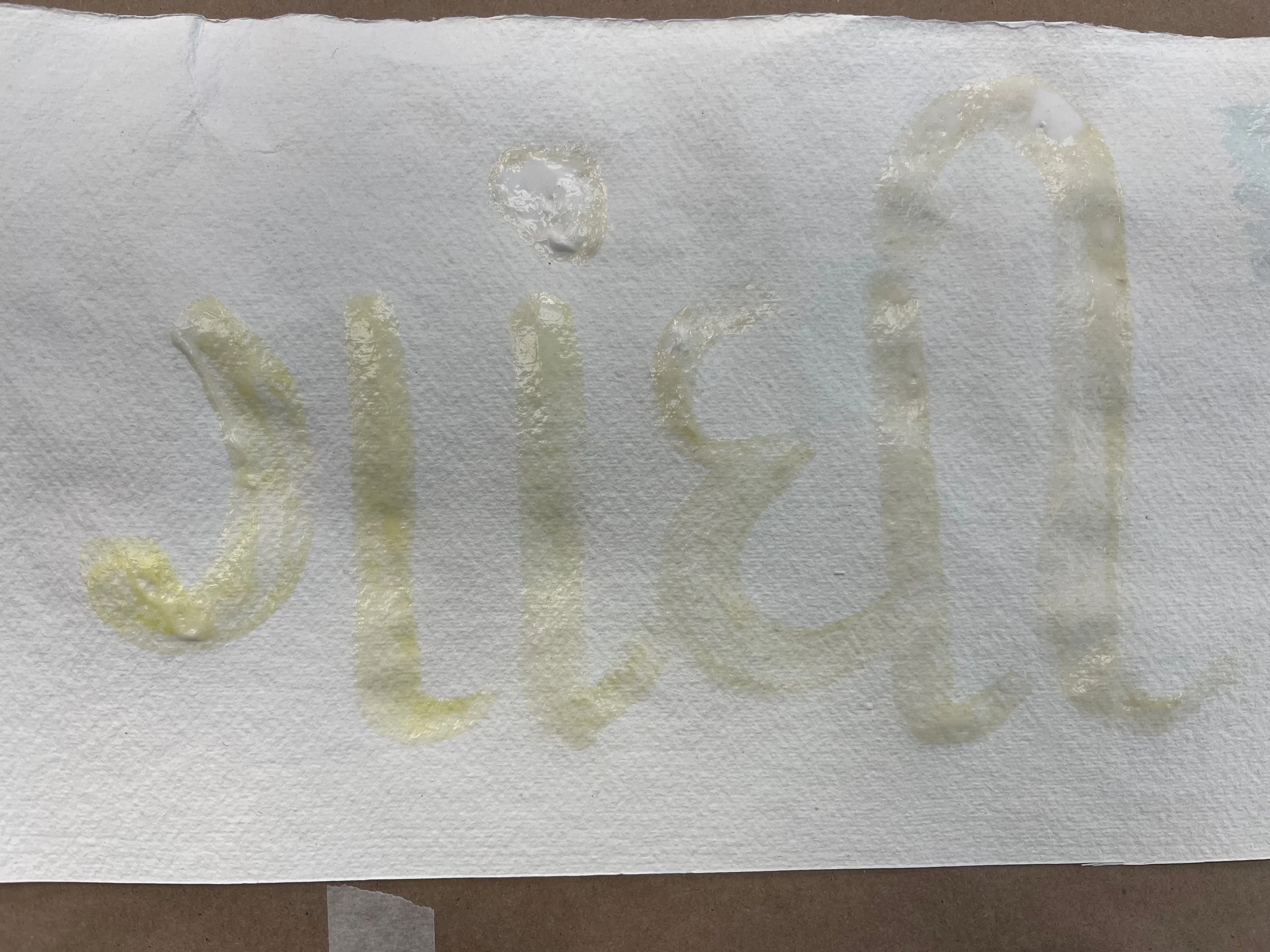
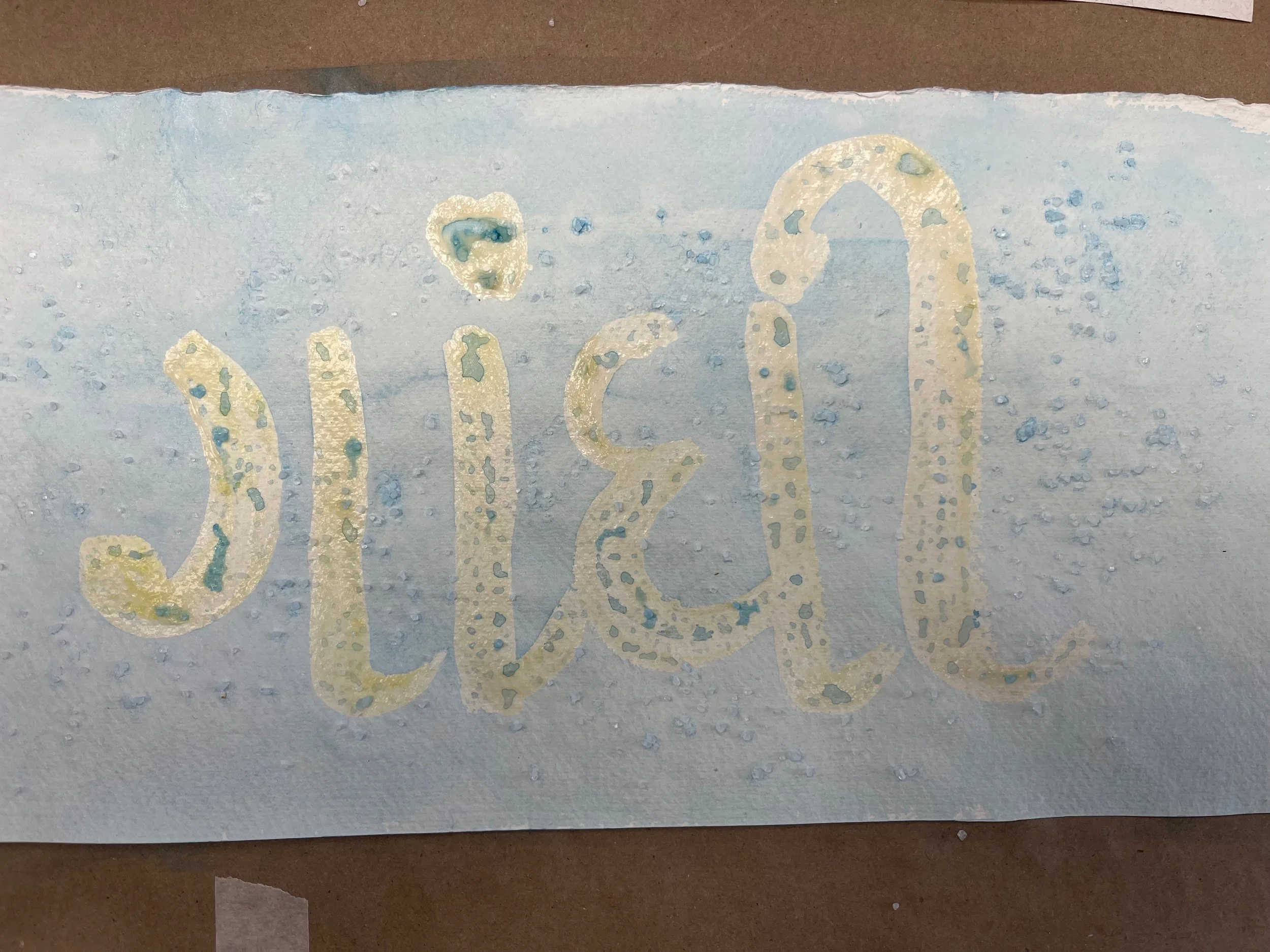
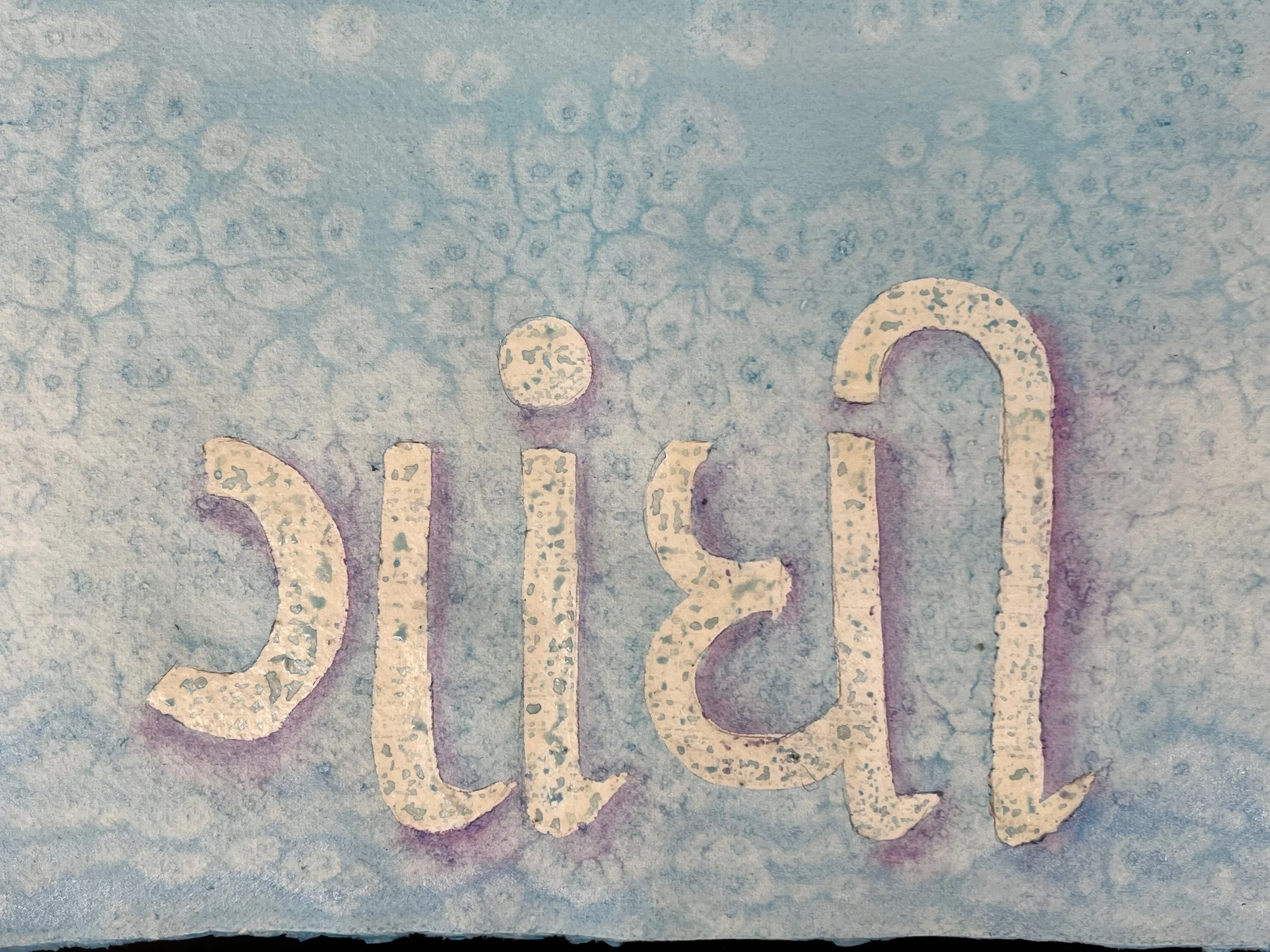
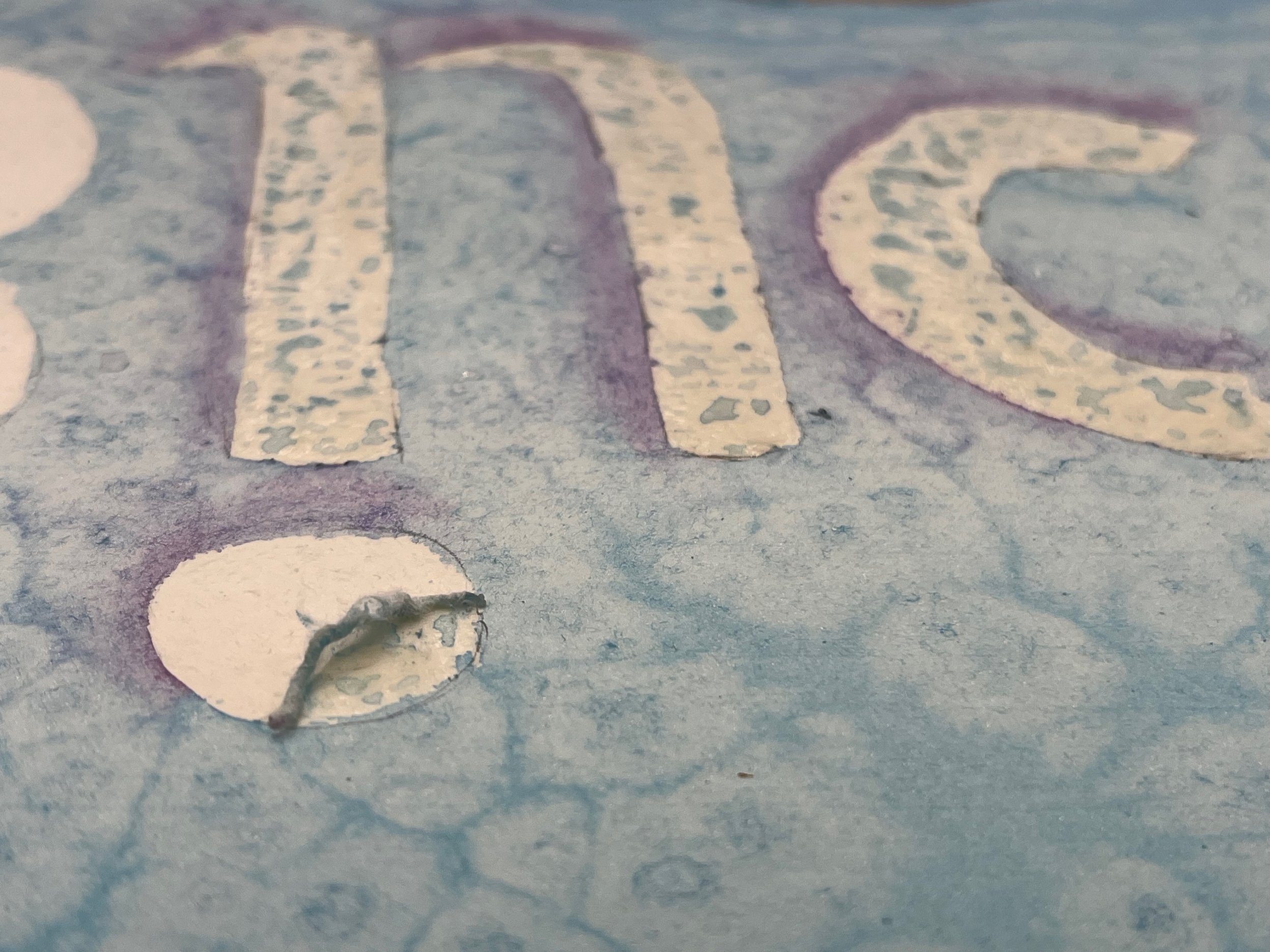
As for the text, obviously I had to write Gandhi in his native Gujarati, a script I had never written before. For this I found a font online and printed it. I decided to use masking fluid to fill the text with and used watercolors sprinkled with salt crystals to make the artwork around it. I practiced it all on one half sheet. Then I removed the masking fluid slowly. Then one day as David Ramos, an amazing painter was at the Studio, I told him how I worried I would ruin it and run out of paper. He said he would step in to help if needed and encouraged me to paint. When I did the blue and sprinkled the salt, he told me to use some purple for definition at the bottom of the text and so I did that. It really worked. However, because of the texture of the khadi paper, when I took off the masking fluid, some of the paper tore. Oh well. It was worth the experiment and I really enjoyed using the metallic German watercolors.
Do Americans even know these stories? Nope. Everyone who has seen them so far, including some very smart people who are into Virginia history, do not know of these stories. It excites me as I always like to point out the knowledge immigrants have which native-born Americans have no idea of. And it was very cool to share these stories at HistoryFest, Arlington County’s celebration of Virginia’s 250th. The Gandhi story was also part of the Multicultural training I did using 4 artworks and poem from our VA250 exhibit for Arlington county employees.
So all in all, very happy with how this project turned out.
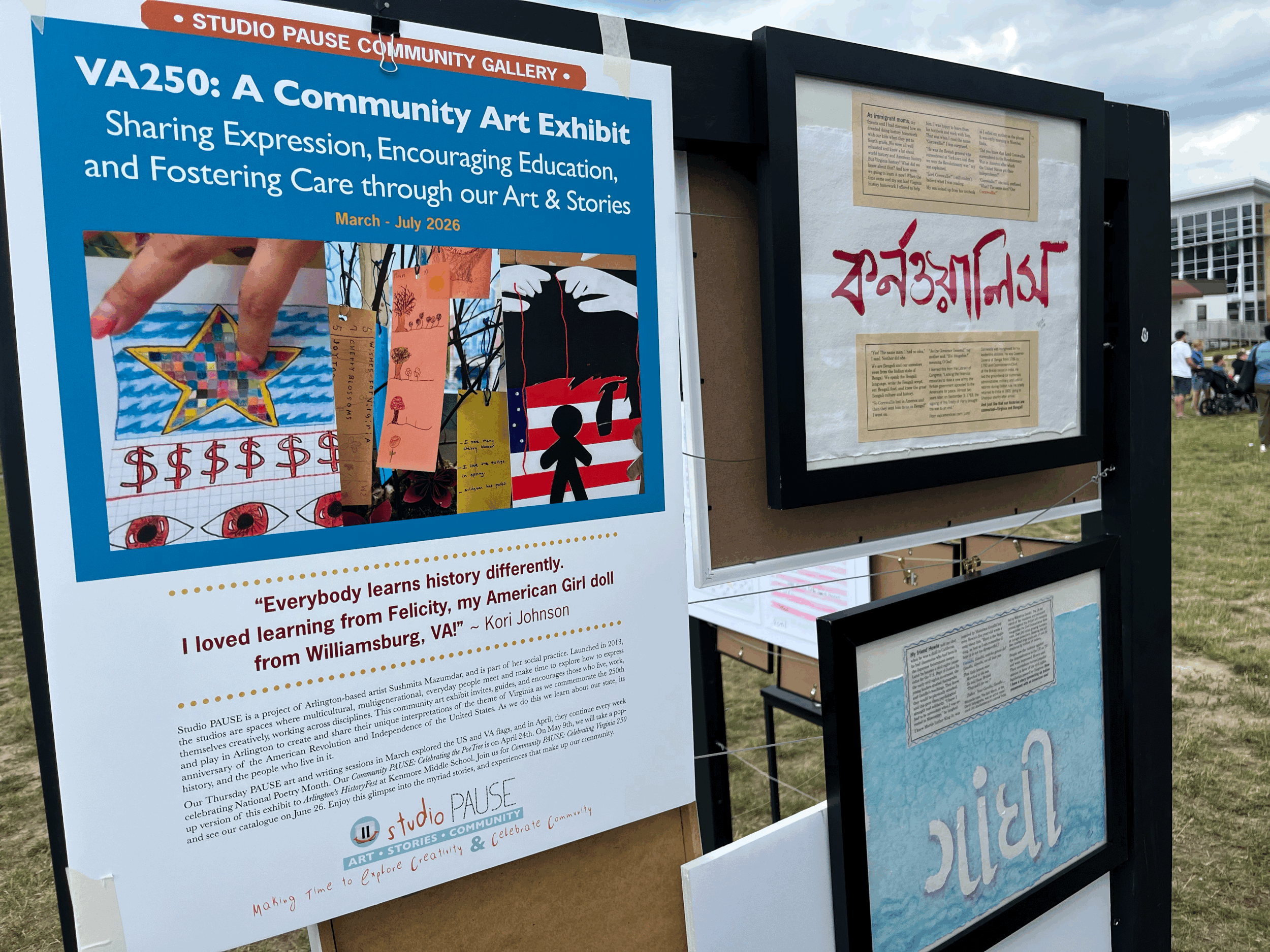
Photo, above: Two artworks from the series Our Histories Are Connected! with the exhibit label at the exhibit at HistoryFest, Kenmore Middle School, Arlington, VA, May 9, 2026.
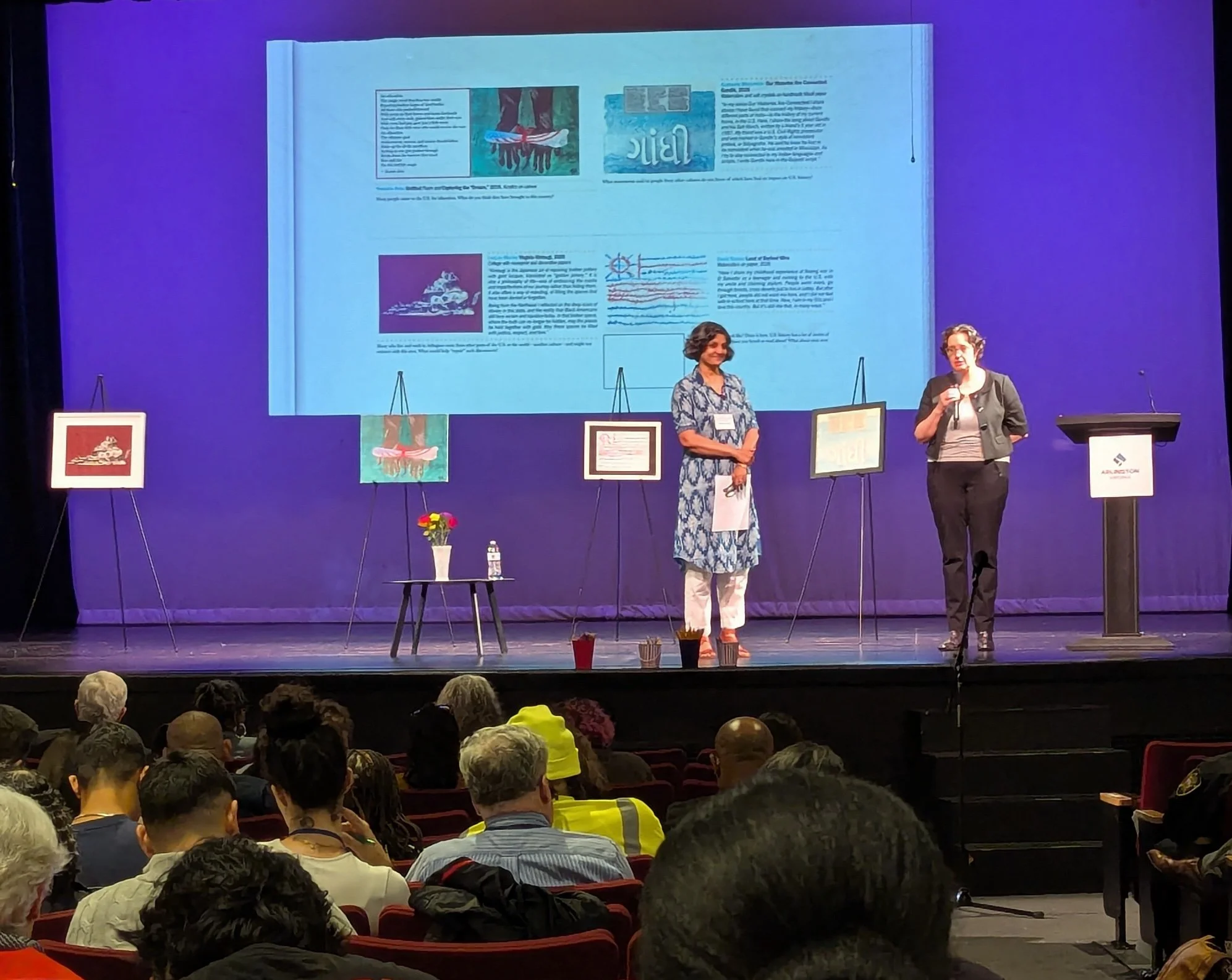
Photo, above: Cynthia Liccese-Torres, Race and Equity Programs Manager, Arlington County Manager’s Office invited Sushmita to present a multicultural training at their RACE Exchange L.I.V.E. event, May 2026, at Gunston Middle School. Sushmita used 4 artworks and a poem from the VA250 exhibit with prompts for the County employees and contractors to respond to. We got 75 responses!
After the RACE Exchange L.I.V.E. event, I got an email from a county employee who worked with Arlington Public Libraries. When she heard my story about “my good friend "Howie," with the briefest description that he's a civil rights lawyer, she thought “I bet it's the Howie Feinstein I know.” They both attend Beth Chai Jewish Humanist Congregation, and his grandson is in her daughter's class. She said she zipped it off a text asking if he knew me — and he confirmed: she's my dear friend! And so I was invited to bring my story to LibraryFest and their “Words Matter Stage”! Of course, I took all the PAUSErs who had poems in the exhibit as well. The library staff who was running the programs at the Words Matter Stage said she enjoyed the stories along with the poems other PAUSErs shared. What a wonderful small world it is and how our stories are all connected!
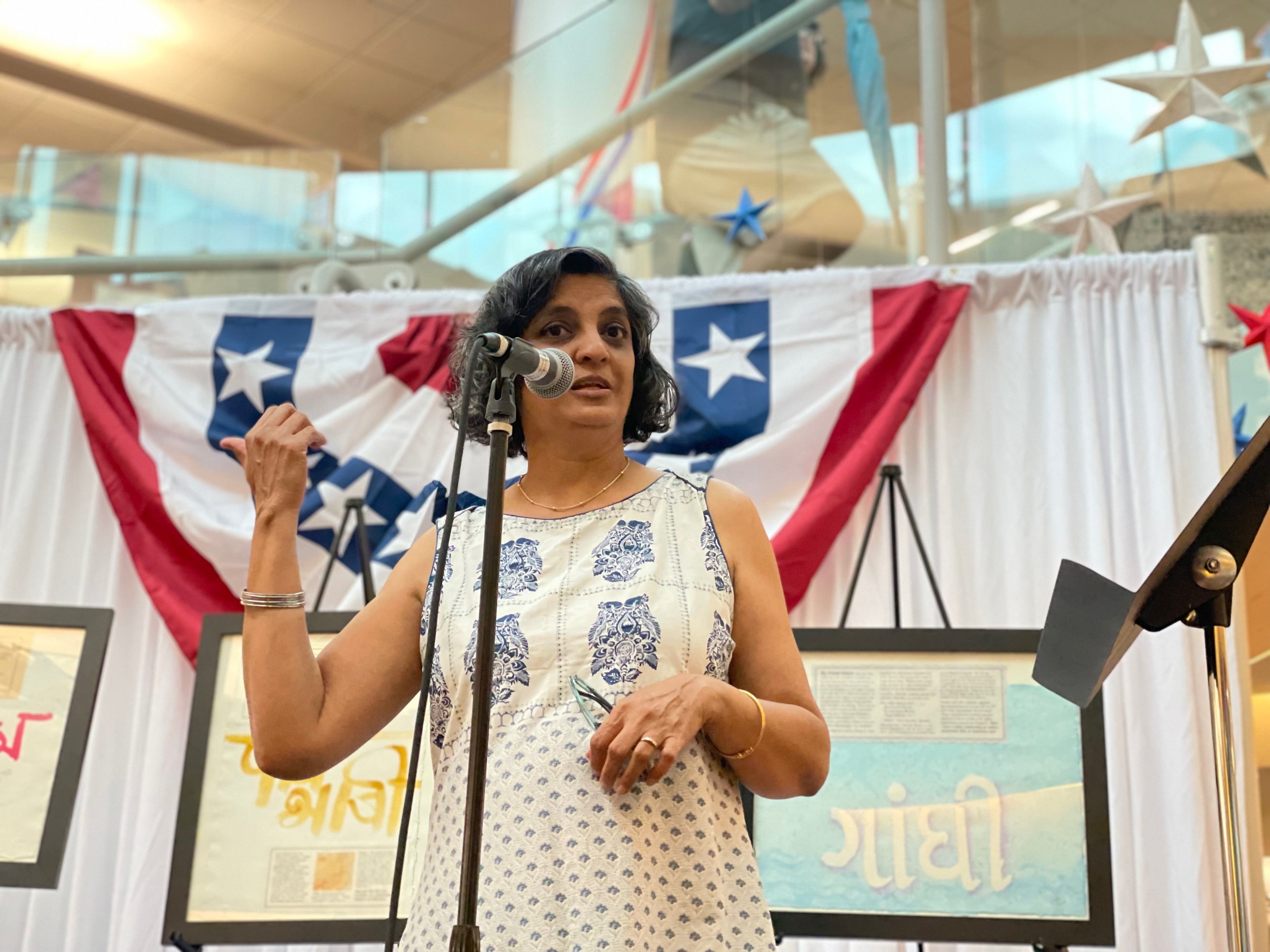
Photo, above: A lovely photo by Flor of me reading the stories at LibraryFest, Arlington Central Library, June 18, 2026. All three artworks displayed behind me.
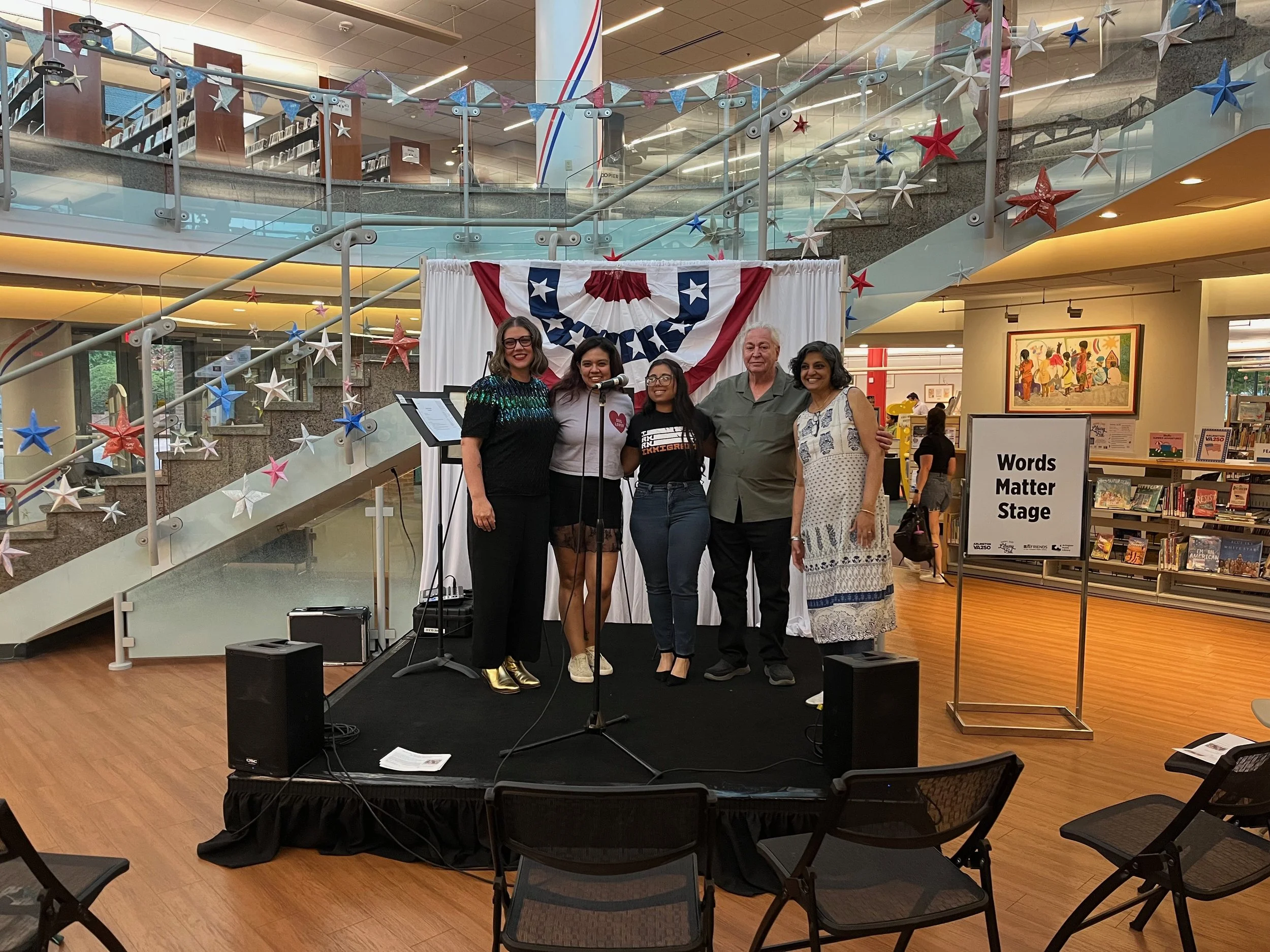
Photo, above: From left Angelina Ribeiro Jones, Yessenia Arias, Flor, Jorge Rogachevsky, and me at the Words Matter Stage, LibraryFest 2026.